Google's Pixel Tag tracker goes on sale at $29.99 for Android's Find Hub
The slim, buttoned tracker uses ultra-wideband and Bluetooth 6.0 for close-range finding, but its most precise features depend on which Android phone you own.
Correction, . An earlier version gave November 10 as the Pixel Tag's on-sale date, listed a pale green colour and said Google's NFC works differently from Apple's. Google's posts give November 11 (The Verge and TechCrunch reported it available on November 10), TechCrunch says the green option was withdrawn, and TechCrunch's updated report no longer supports the claim that Google's NFC works differently; Google's own posts do not mention NFC.
- What happened
- Google's Pixel Tag item tracker, announced in August, went on sale for $29.99, or $99.99 for a four-pack; Google gives the date as November 11, while The Verge and TechCrunch reported it available on November 10.
- What’s new
- It is Google's own tracker for the Find Hub network, which until now relied on third-party tags from companies such as Samsung, Motorola and Pebblebee.
- Why it matters
- Android users get a first-party AirTag-style tracker, though precise direction-finding works only on phones with ultra-wideband hardware.
Google has started selling the Pixel Tag, its own lost-item tracker for Android. The company first announced it in August. Google's own posts give November 11 as the on-sale date, while The Verge and TechCrunch both reported it available on Tuesday, November 10. A single tag costs $29.99 and a four-pack costs $99.99. It comes in a silver shade called Fog. TechCrunch says the Google Store showed a pale green option earlier on launch day and then removed it. The Verge notes that Android's tracking network previously relied on third-party trackers from Samsung, Motorola and Pebblebee. The Pixel Tag works with Google's Find Hub app and network.
A thinner, oblong alternative to AirTag
Both outlets present the tag as Google's answer to Apple's AirTag, and The Verge says it is priced similarly to the AirTag 2. TechCrunch reports the Pixel Tag is 1.1 inches wide and 1.8 inches tall, against the AirTag's 1.26-inch width. It is 0.2 inches thick, against the AirTag's 0.31 inches. It weighs 0.4 ounces with the battery. The Verge says that makes it slightly lighter than the AirTag 2. TechCrunch's figures refer only to "the AirTag" without naming a model.
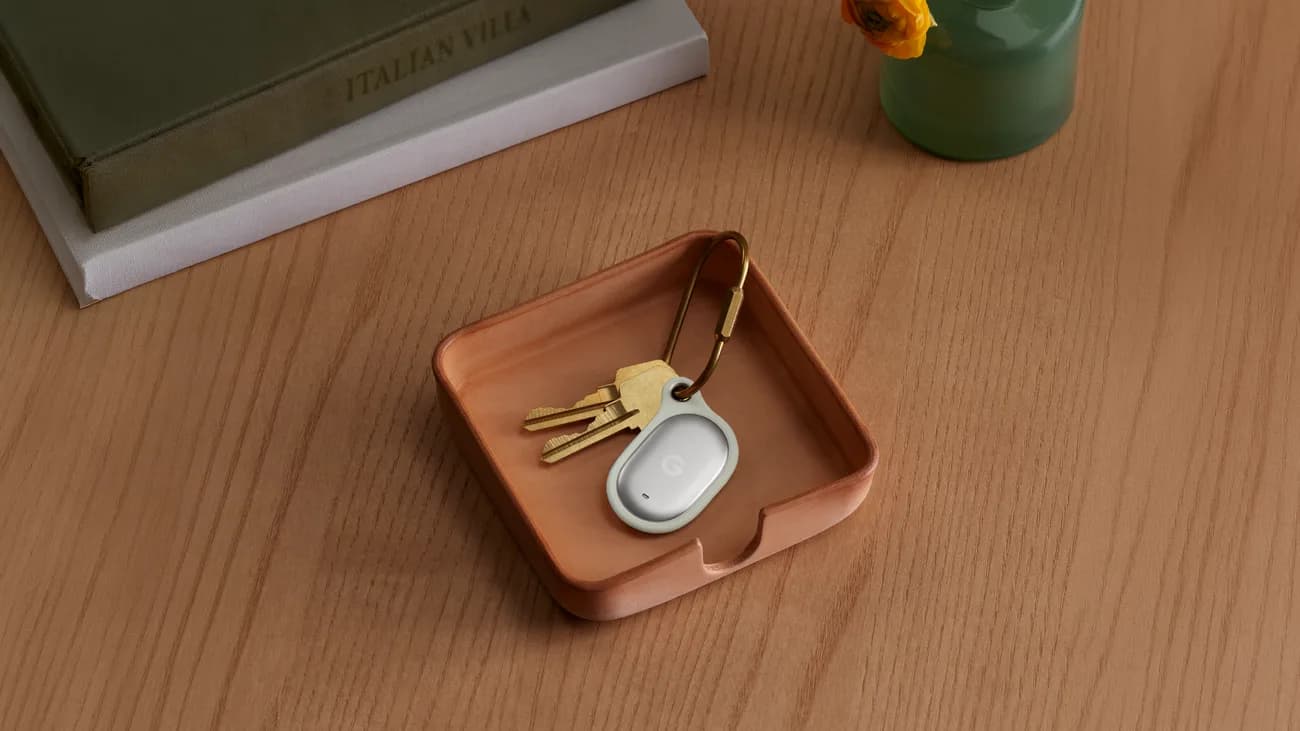
The tag has a stainless steel body and no hole for attaching it to keys or bags, so it needs a holder. Bellroy is launching keychain cases sold through the Google Store. Unlike the AirTag, the Pixel Tag has a physical button. TechCrunch says a double press rings a misplaced phone. A built-in speaker can also chime to help locate the tag, with three volume levels and a maximum of about 80 decibels.
Precision finding depends on the phone
The tag supports ultra-wideband (UWB) and Bluetooth 6.0 Channel Sounding, and the two do different jobs. According to The Verge, phones with a UWB chip can show both the distance and the direction to a nearby tag in Find Hub. Channel Sounding shows distance only. The tag pairs with phones running Android 9 or later through Fast Pair. However, the precise-locating features need a phone with UWB or Bluetooth 6.0. TechCrunch adds that Pixel Watch owners can also use the directional guidance.
For items that are farther away, the tag relies on Google's crowdsourced network. TechCrunch says that network covers more than a billion Android devices, and it shows locations on a map in Find Hub. A tag's location can be shared with up to 10 people.
NFC arrives
TechCrunch updated its report to note that the Pixel Tag supports NFC. Google had not mentioned this in August. Apple uses NFC so that a stranger who finds an AirTag can tap it to see the owner's contact details. TechCrunch says the tag supports NFC and that tapping it opens the tag's details screen in Find Hub. It says Google now does something similar to Apple's tap for contact details, but also that a finder cannot tap the tag, so what a finder sees is unclear; Google's own posts do not mention NFC. Finders can still get in touch through Lost mode, which shares the owner's email, phone number and a short message. The item is automatically marked as found once it comes back into range of the owner's phone.
Battery and durability
The tag runs on a user-replaceable CR2032 coin cell. Google's own wording varies: its Pixel Tag launch post says the battery lasts up to one year, while its November Pixel Drop post says over a year. Google says its battery figure comes from preproduction units and that actual life may be lower. It is rated IP67 for dust and water resistance. TechCrunch specifies that this means up to 1 meter of water for 30 minutes.