Hugging Face releases RL-trained harness adapters for Qwen3.8-27B
Hugging Face trained one LoRA adapter per agent harness for Qwen3.8-27B and says the pi version lifts a Terminal-Bench 2.1 score from 39% to 55%.
- What happened
- Hugging Face published reinforcement-learning-trained LoRA adapters that tune Qwen3.8-27B for the pi, OpenCode and Hermes Agent coding harnesses.
- What’s new
- Hugging Face reports that the adapters raise accuracy and cut token use, and it has merged all three into one adapter that works in every harness.
- Why it matters
- Hugging Face is publishing the full recipe and artifacts so developers can tune open models for their own agent harness and tasks.
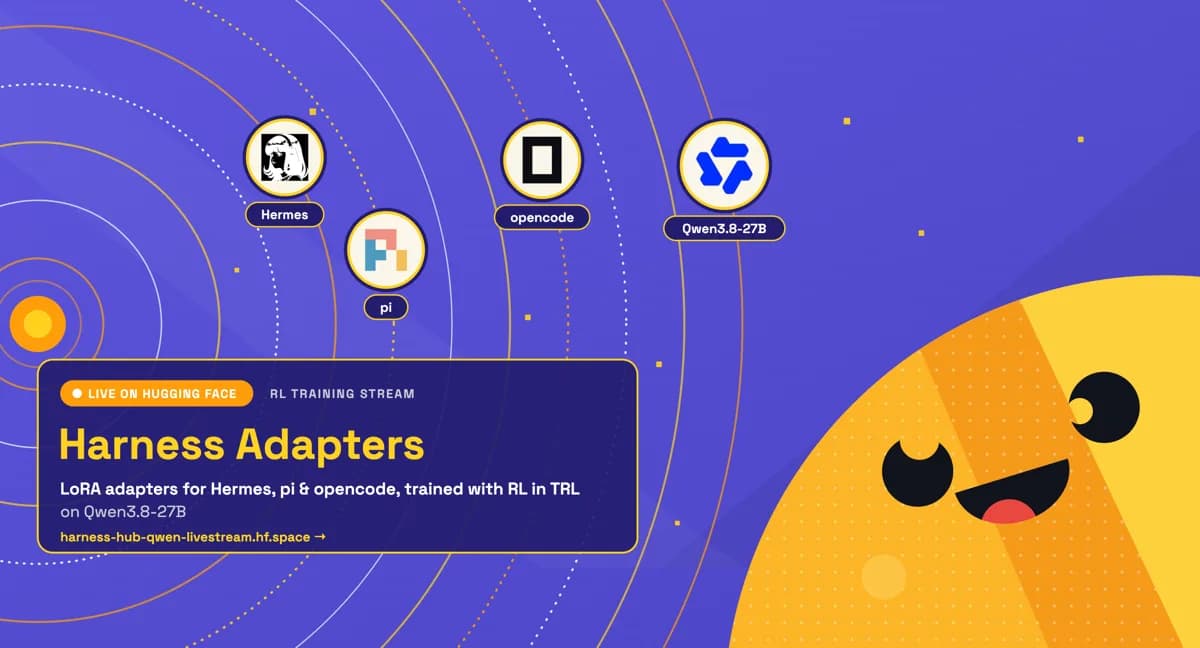
Hugging Face has released a set of LoRA adapters that adapt the open Qwen3.8-27B model to specific coding-agent harnesses, along with the data, tooling and recipe used to train them.
Hugging Face's argument is that general-purpose models are not tuned for any particular harness or workload, so pairing them leaves accuracy and efficiency unused. To address that, the team trained one adapter per harness for pi, OpenCode and Hermes Agent, running reinforcement learning inside the unmodified harness rather than a re-implementation of its agent loop. The trainer learns from the tokens the harness actually produced, captured by a proxy sitting between the harness and vLLM.
The company's headline figure: with the pi harness, the base model scores 39% on Terminal-Bench 2.1 using about 2.9K tokens per task, while the frozen model plus the pi adapter reaches 55% pass@1 at about 1.5K tokens. Hugging Face attributes most of the gain to the model reasoning less, making fewer tool calls and getting tasks right on the first attempt. It says every adapter outperforms the unmodified model, in both accuracy and efficiency, when run in its matching harness on the two benchmarks it tested.
Training used TRL's AsyncGRPOTrainer, OpenEnv and Harbor, with each adapter trained on two Nvidia B200 GPUs. The task dataset, harness-hub/agentic-coding-envs, holds 871 tasks, of which 171 the base model solved only some of the time. Only those partially solved tasks were used for training.
The three adapters have also been merged into a single adapter that Hugging Face says runs unchanged under all three harnesses. These are Hugging Face's own results, and the post itself lists what the model actually learned as an open question.